
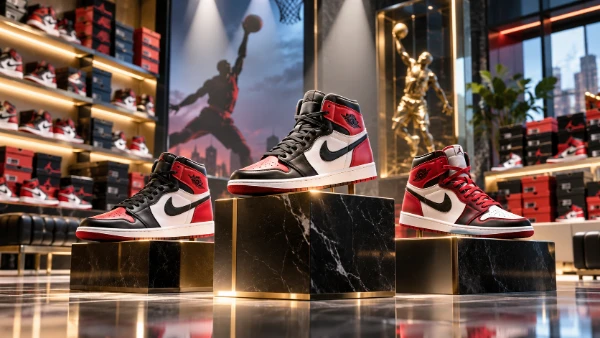
Why Jordan Brand Revenue Fell in 2026 and How Nike Is Trying to Restore Exclusivity
Jordan Brand entered 2026 from an unusual position. It remained one of Nike’s largest and most recognisable businesses, yet the very products that had supported years of growth were becoming too widely available. Nike reported Jordan Brand revenue of $7.034 billion for the fiscal year ended 31 May 2026, compared with $7.270 billion in fiscal 2025. That represents a 3% decline on a reported basis and a 5% decline when currency movements are excluded. The fall was not simply the result of consumers suddenly losing interest in Michael Jordan’s signature line. Nike had started deliberately reducing parts of its lifestyle footwear supply, including the Air Jordan 1, while dealing with excess stock, widespread discounting and weaker trading in important markets. By October 2026, management was describing an even broader reset: fewer selected Retro releases, lower volumes and a renewed attempt to make the Jumpman feel less commonplace.
Why Jordan Brand Revenue Fell in Fiscal 2026
The headline number needs some context. Jordan Brand had generated $7.270 billion in fiscal 2025 after reaching $6.988 billion in fiscal 2024, so the 2026 result did not represent a collapse of the business. Revenue remained above the level recorded two years earlier. What changed was the direction of travel. After years in which Nike successfully expanded Jordan beyond a relatively narrow sneaker audience, the company had reached a point where continuing to push more units of familiar footwear was becoming counterproductive. Fiscal 2026 therefore became partly a correction year, with Nike accepting weaker short-term sales while trying to improve the quality of future demand.
One of the clearest pressures came from Nike’s decision to reduce the supply of major lifestyle franchises. The company repeatedly identified Air Force 1, Dunk and Air Jordan 1 as products that had become too large within its footwear mix. For Jordan Brand, the Air Jordan 1 was particularly important because it had evolved from a historically significant basketball shoe into a mass-market lifestyle franchise offered across numerous colourways, price levels and release cycles. High availability had supported large sales volumes, but it also meant shoppers had fewer reasons to treat every launch as an event. Nike began cutting supply rather than continuing to maximise the number of pairs sold.
This strategy had an immediate mathematical consequence. Selling fewer pairs of a major franchise reduces revenue before any longer-term benefit from stronger demand or cleaner inventory can appear. Nike acknowledged throughout its fiscal 2026 reporting that product and marketplace changes could have a negative effect on revenue and profitability while the company reduced older stock and made room for newer products. Across Nike Brand footwear, fiscal 2026 revenue was broadly flat on a reported basis and down 2% without currency effects. Jordan therefore operated inside a wider footwear reset, but its dependence on highly established Retro models made the adjustment particularly visible.
Oversupply Changed What an Air Jordan Release Meant
Air Jordan Retros historically benefited from a simple commercial advantage: many important releases were difficult to obtain. Limited quantities, long gaps between returning colourways and strong connections to Michael Jordan’s playing career created urgency. Buyers often had to act at launch rather than wait for a later discount. As Jordan Brand expanded, Nike was able to turn that demand into a much larger global business, but the number and availability of Retro products also increased. By October 2026, Nike management publicly acknowledged that the company had been oversupplying iconic Jordan Retro footwear and relying too heavily on those products to carry the business.
The problem with oversupply is not merely that unsold shoes occupy warehouse space. It changes consumer behaviour. A customer who believes that a shoe will remain available for weeks has less incentive to buy it immediately. If similar models regularly appear at reduced prices, paying the original retail price becomes harder to justify. That dynamic can gradually weaken the distinction between a special release and normal seasonal stock. Nike’s own fiscal reporting shows why this mattered across its wider business: during fiscal 2026 the company was still using markdowns, returns and discounts to clear inventory and create space for new products. Those measures help remove older stock, but repeated discounting can train customers to wait.
The situation became even clearer after the end of fiscal 2026. During Nike’s first-quarter fiscal 2027 earnings discussion on 1 October 2026, management said Jordan Brand represented approximately 13% of the company’s global business during the quarter and that Jordan revenue had fallen by a mid-teens percentage. That decline was substantially sharper than the 3% reported fall for the previous full fiscal year. Crucially, Nike presented part of this pressure as intentional. The company was reducing the volume and frequency of specific Retro launches rather than trying to replace every lost sale immediately. In other words, short-term revenue was being sacrificed to correct a problem created by excessive availability.
How Nike Is Rebuilding Scarcity Around Jordan Brand
Nike’s response is centred on supply discipline. In October 2026, chief executive Elliott Hill said Jordan footwear would return to the scarcity model that helped establish the business. The practical meaning is straightforward: selected Jordan Retros will be produced in lower volumes and released less frequently. Nike had already applied that approach to the Air Jordan 1, and management said similar decisions would extend to specific Retro launches. This is not the same as making every Jordan shoe rare. The company still needs a broad commercial range, but its most culturally important products cannot perform the same role as permanently available everyday footwear.
The distinction matters because Jordan Brand serves several different customers. Some buyers want historically accurate Retros associated with particular seasons or moments from Michael Jordan’s career. Others buy modern basketball shoes, lifestyle models, clothing, golf products or training footwear. Treating all of these categories in the same way would limit growth. Nike’s 2026 strategy instead points towards tighter control of heritage products while developing more areas of the Jordan business that do not depend on repeatedly returning to the same classic silhouettes. That gives the company a way to reduce Retro supply without making the entire brand smaller by design.
Nike is also coordinating the change with wholesale retailers. Management said it had discussed the reduction in Jordan Retro volume and launch frequency with its partners, an important step because scarcity cannot be created only through Nike’s own stores and digital sales. If large quantities remain available elsewhere, the effect is diluted. At the same time, Nike has been rebuilding wholesale relationships after a period in which it placed greater emphasis on direct sales. Fiscal 2026 Nike Brand wholesale revenue rose 6% on a reported basis to $27.5 billion, while Nike Direct revenue fell 6% to $17.7 billion. Jordan’s reset therefore has to balance wider retail distribution with tighter control over which products reach those retailers and in what quantities.
Fewer Retro Launches Are Only Part of the Strategy
Reducing supply can create more urgency, but scarcity alone cannot sustain a brand of Jordan’s size. Nike also needs products that give customers reasons to buy something other than another familiar Retro. That is why the company’s broader turnaround has placed more attention on innovation, performance sport and a more balanced footwear portfolio. Jordan has long had a strong basketball identity, but its commercial reach now extends well beyond basketball courts. Nike has pointed to opportunities in areas such as golf, American football cleats and training, allowing the Jumpman identity to appear in sport without relying entirely on models originally created for Michael Jordan decades ago.
This approach also addresses one of the structural risks created by the success of Retros. When a heritage catalogue becomes too commercially important, each new season depends heavily on persuading customers to buy another variation of shoes they already know. Colour changes and anniversary reissues can remain valuable, but they cannot substitute indefinitely for new ideas. Nike’s challenge is therefore to protect the cultural value of shoes such as the Air Jordan 1 while giving newer Jordan products enough design, athlete support and retail visibility to build their own audiences. A stronger new-product pipeline would make it easier to keep classic releases selective rather than increasing Retro supply whenever additional revenue is required.
Marketing is changing alongside the product mix. Nike increased its overall demand-creation spending in several periods during the turnaround and has renewed its emphasis on major sporting moments, athletes and product launches. For Jordan Brand, that offers a way to reconnect the Jumpman with competition rather than allowing it to function mainly as a lifestyle logo. The strategy is especially relevant for younger buyers who did not watch Michael Jordan play for the Chicago Bulls. Heritage remains an enormous asset, but long-term relevance requires current athletes, contemporary products and stories connected with sport today. Nike’s task is to make the history valuable without allowing the business to become dependent on nostalgia.
Why the Jordan Reset Extends Beyond Sneaker Supply
The revenue decline cannot be separated from Nike’s difficulties in Greater China. In the first quarter of fiscal 2027, which ended on 31 August 2026, Nike Brand revenue in Greater China fell 22% on a reported basis and 26% without currency effects. Footwear revenue in the region fell 22% reported and 26% currency-neutral. These figures cover Nike Brand as a whole rather than Jordan alone, but they show the weakness of a major market in which both Nike and Jordan operate. Nike has cited lower store traffic, high inventory levels and heavy promotional activity as problems in Greater China, making the region an important part of the wider effort to improve how its products are presented and sold.
Digital sales have also been under pressure. For fiscal 2026, Nike Brand Digital sales fell 12% to $8.6 billion, with the company pointing primarily to reduced traffic. In the first quarter of fiscal 2027, Nike Direct revenue declined another 8% on a reported basis, while Nike Brand Digital was down 13%. Again, these numbers are broader than Jordan Brand itself, but they matter because Jordan products are heavily represented in Nike’s direct retail ecosystem. A release strategy based on excitement and scarcity works less effectively when overall digital traffic is falling or when shoppers expect older products to move into promotional sales.
Nike is consequently trying to change both product availability and the environment in which products are sold. Its fiscal 2026 filings described efforts to reduce selected footwear supply, clear excess inventory, increase the share of new products and improve presentation in physical retail. By the first quarter of fiscal 2027, company-wide inventory stood at $7.8 billion, 3% below the previous year. Inventory reduction alone does not prove that Jordan’s problems are solved, but it provides evidence that Nike is moving away from the period in which too much ageing merchandise competed for attention with new releases.
Restoring Exclusivity Will Take More Than Making Shoes Harder to Buy
The biggest test for Jordan Brand is whether lower supply improves demand quality rather than simply reducing sales. If consumers respond to fewer Retro launches by buying closer to release dates and at full price, Nike can operate a healthier business even with fewer units. If demand does not strengthen, scarcity would merely make a declining category smaller. That distinction explains why Nike is combining supply cuts with investment in product, sport and retail presentation. Management’s language in October 2026 was unusually direct: the intention is for the Jumpman to feel special again and for Jordan Brand to remain coveted over the coming decade, not simply to produce an immediate quarterly sales rebound.
The timing also means future financial results need to be interpreted carefully. Nike has said North America will experience a significant near-term effect from lower Jordan Retro volumes. Therefore, another period of declining Jordan revenue would not automatically mean the strategy is failing. A deliberate reduction in units can depress sales while improving full-price demand, reducing promotional stock and making individual releases more distinctive. Measures such as sell-through at launch, the level of discounting, retailer inventory and demand for newer non-Retro products will be useful alongside headline revenue when judging whether the reset is working.
As of October 2026, Jordan Brand remains a multibillion-dollar business, but Nike is no longer treating maximum availability as the safest route to growth. Fiscal 2026 revenue fell from $7.270 billion to $7.034 billion, and the sharper decline reported for the following quarter shows that the correction is still under way. Nike’s response is to sell fewer selected Retros, reduce launch frequency, clean up inventory, work more closely with wholesale partners and expand Jordan’s relevance in current sport. The strategy carries an obvious short-term cost: restricting products that once generated enormous volume means giving up sales today. Nike is betting that preserving the value attached to the Jumpman is worth more than keeping every Retro widely available.