
Michael Jordan Training Without Myths: Which 1990s Methods Still Work in 2026
Michael Jordan’s training is often retold as folklore: endless reps, superhuman pain tolerance, and mysterious “secret sessions”. The reality is more useful than the legend. Jordan’s best years were built on clear physical goals—getting stronger without getting slower, adding contact tolerance, sharpening coordination under fatigue, and recovering well enough to repeat high output for months.
Strength that didn’t steal speed: why Jordan added muscle and how the work was structured
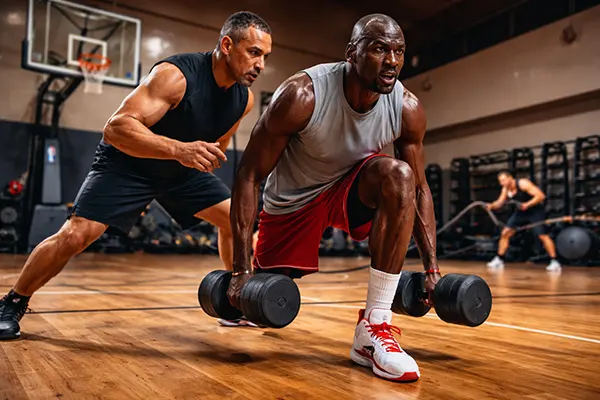
By the late 1980s and into 1990, Jordan had a problem that skill alone couldn’t solve: repeated physical punishment from elite defences. The response wasn’t random bodybuilding. With performance coach Tim Grover, the aim was to add functional mass and strength that improved Jordan’s ability to absorb contact, maintain balance, and finish plays through bumps. A widely documented marker of that shift is Jordan’s move from about 200 pounds to around 215 pounds, built gradually rather than in one risky bulk.
The key idea—still modern in 2026—is that strength work has to serve a basketball job description. For a guard/wing, that means force production from the hips and legs, trunk stiffness for contact and landing, and shoulder/upper-back strength for fighting through grabs without ruining shooting mechanics. In practice, this becomes a plan built around a few core lifts (squat/hinge patterns, presses/pulls), loaded carries, and targeted work for the feet, calves and posterior chain. The sessions don’t have to be long, but they have to be repeatable and progressed.
What separates “useful strength” from gym noise is how load is managed across the week. In Jordan’s era, the story is often “he just outworked everyone”. The better interpretation is that hard strength sessions were placed so they didn’t sabotage key on-court work, and progression was steady. In today’s elite game, the same principle shows up as planned heavy exposures, then lower-volume maintenance during dense competition blocks. Research still supports strength training as a driver of improved maximal force and power qualities in athletes, when programmed sensibly.
What 2026 sports science keeps, and what it changes
The part that holds up is the goal: increase force capacity so the same basketball actions cost less. Modern evidence backs the idea that well-designed strength training improves lower-body strength and can support sprint and jump outcomes in court athletes, especially when combined intelligently with power work. That is why elite players in 2026 still lift heavy—just with tighter volume control and more attention to fatigue spillover.
The change is in how coaches protect the “speed reserve”. You can’t grind strength year-round and expect elastic movement to remain sharp. A modern version of the Grover-style approach typically uses fewer “junk” sets, more intent-based reps, and better exercise selection (trap-bar deadlift variants, split squats, heavy sled pushes, isometrics) to get high force without excessive soreness. It also adds more eccentric control work for deceleration because modern spacing and pace create more high-speed stops than 1990s half-court basketball.
Finally, today’s best strength programmes track readiness rather than guessing. Teams commonly use wellness check-ins and objective signals (for example, heart-rate variability trends) to decide when to push and when to hold steady. That doesn’t make training soft—it makes it sustainable across an 82-game season, travel, and playoff intensity.
Speed, jumping and coordination: the “athletic” layer that made the strength usable
Jordan’s game was explosive, but it wasn’t only about vertical jump height. His advantage came from repeated fast actions: first step, second jump, mid-air adjustment, and the ability to land and go again. Training for that in the 1990s looked like a blend of sprint mechanics, agility patterns, and jump work—often in short bursts that kept quality high.
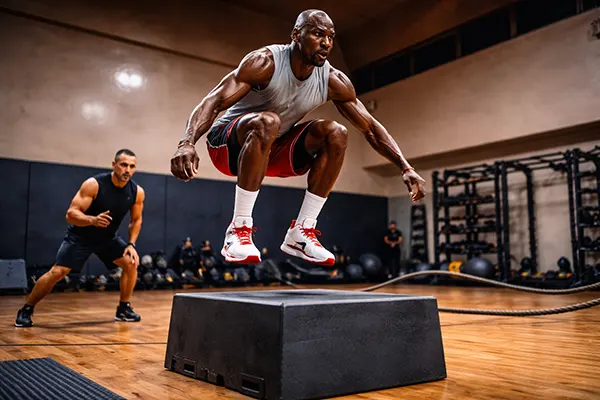
Plyometrics still matter in 2026 because basketball is a sport of elastic rebounds: quick ground contacts, reactive hops, and violent braking. Modern research continues to show that plyometric programmes can improve jump and speed-related qualities in basketball populations. The important detail is dosing. Two high-quality plyometric exposures per week, carefully progressed, usually beats daily high-volume jumping that inflames tendons and steals freshness.
Coordination is the quiet engine behind “Jordan moves”. It is not only footwork drills—it is the ability to express force in the right direction, at the right time, while reading contact and maintaining body control. That means training patterns that link hips, trunk and shoulders: rotational throws, controlled landing mechanics, lateral bounds with stick-and-hold, and reactive change-of-direction tasks that stay crisp rather than sloppy.
The modern translation: power sessions that protect knees, ankles and tendons
In 2026, elite players still do jump training, but the smartest programmes treat tendons like long-term investments. You build capacity first (calf raises with heavy loading, isometrics for Achilles/patellar tendon comfort, controlled eccentrics), then add higher-speed plyometrics. This sequencing is one reason modern players can maintain explosiveness deeper into the season than athletes who jump hard before their tissues are ready.
Deceleration work is now non-negotiable. The 1990s game had plenty of contact, but today’s pace and spacing drive more high-velocity stops and re-accelerations. So modern coordination blocks often include braking mechanics, single-leg landing strength, and posterior-chain eccentrics. This is where exercises like Nordic hamstring variations and targeted adductor strength (commonly used in injury-risk reduction across running-and-cutting sports) fit as supportive tools rather than “magic bullets”.
The final update is integration: power work is arranged around basketball skill sessions. If a player has a heavy on-court day (high-intensity scrimmage, lots of max-speed actions), the power training becomes lighter and more technical. If on-court work is lower intensity, the gym can carry the explosive load. That simple alignment—rather than chasing fatigue—keeps speed qualities sharp.
Recovery and longevity: what Jordan’s era didn’t measure, and what 2026 does
One myth is that 1990s champions ignored recovery. They didn’t “ignore” it; they simply had fewer tools to quantify it. Jordan’s generation relied more on routine, intuition, hands-on treatment, and basic nutrition habits. The modern game keeps the routine part but replaces guesswork with monitoring and clearer recovery priorities.
Sleep is the biggest upgrade. In 2026, it is no longer treated as a motivational slogan; it is a performance variable with strong links to recovery, performance consistency, and injury risk in basketball populations. Modern teams manage sleep as actively as they manage practice: travel timing, light exposure, naps, and realistic expectations around back-to-backs.
The other shift is that “hard work” is now separated into training stress and life stress. A player can handle a heavy gym week, but not if combined with poor sleep, chaotic travel, and constant pain. The strongest programmes build recovery into the plan: deload weeks, micro-rest days, and specific tissue-care strategies (calf/Achilles work, hips, trunk) so the athlete stays available.
Coach role in 2026: Grover’s logic with better feedback loops
Tim Grover’s long-running identity is tied to building strength, explosiveness and longevity around the athlete’s competitive needs. The coach’s real job, then and now, is not to collect exercises—it is to manage trade-offs. If a session boosts force but wrecks the player’s shot legs, it is a poor session. If it builds resilience and the player stays sharp on court, it is a good session, even if it looks “basic”.
In modern settings, that management is more data-informed. Coaches may track readiness and recovery markers and adjust training load day-to-day. Heart-rate variability is one widely discussed non-invasive tool used in athlete monitoring, but it’s only helpful when combined with context: travel, soreness, mood, and actual on-court output. The lesson is the same as in Jordan’s best years—train hard, but don’t train blind.
What elite players still borrow from the Jordan/Grover era is the clear hierarchy: build strength to handle contact, keep explosiveness through smart power work, and protect availability through recovery. The difference is that 2026 programmes can be more precise: less wasted volume, fewer “hero” sessions, and more consistency across the season. That is how modern stars stay dangerous in April, not only in October.