
What Parts of Michael Jordan’s Game Modern NBA Players Still Copy
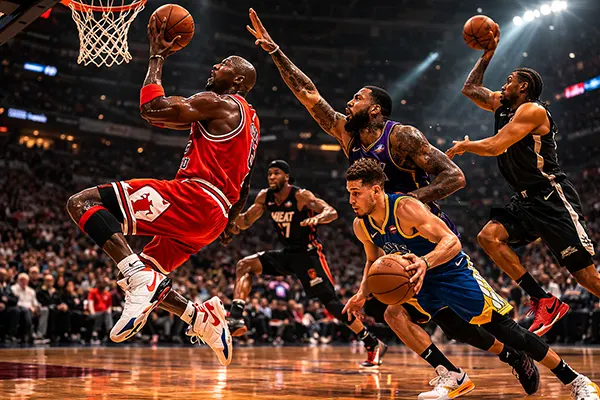
Michael Jordan’s influence on basketball did not end with his final NBA season. More than two decades later, many of the techniques that defined his style remain visible in the way elite players approach scoring, footwork and mental control during games. Coaches and analysts often point out that Jordan’s technical foundation — rather than only his athletic ability — created a blueprint for perimeter players. Elements such as his footwork in the post, his mid-range efficiency, his fadeaway shot and the psychological pressure he placed on opponents continue to shape modern offensive play in the NBA.
Post Footwork and Balance: A Technical Foundation
One of the most underrated parts of Michael Jordan’s offensive game was his post footwork. While many shooting guards of the late 1980s relied mainly on perimeter scoring, Jordan developed a strong back-to-the-basket approach, particularly during the second half of his career. His pivots, shoulder fakes and quick turns allowed him to create space against defenders who were often taller and stronger.
Jordan worked closely with Chicago Bulls assistant coach Tex Winter, who helped refine his movements within the triangle offence. The system required players to read defenders and react with precise foot placement rather than relying purely on speed. Jordan mastered drop steps, reverse pivots and quick spin moves, turning the low post into a scoring area for a guard.
Modern NBA players continue to replicate these movements. Guards and wings today spend significant time training footwork drills that resemble Jordan’s post routines. Even in a league dominated by three-point shooting, the ability to score efficiently in the mid-post remains a valuable skill.
Players Who Adopted Jordan’s Post Techniques
Kobe Bryant became perhaps the most visible example of a player who studied Jordan’s post play in detail. Bryant often used identical pivot patterns and shoulder fakes, especially during his years with the Los Angeles Lakers under coach Phil Jackson. Film comparison shows that many of Bryant’s scoring sequences mirror Jordan’s footwork patterns.
DeMar DeRozan is another player whose offensive style includes strong mid-post footwork. Unlike many wings in the modern era, DeRozan regularly operates from the elbow and the mid-post, using spins and step-through moves that reflect Jordan’s influence.
Jimmy Butler also integrates similar mechanics when attacking smaller defenders. His ability to create contact, pivot and finish from the mid-range area echoes techniques that Jordan used throughout the 1990s.
The Mid-Range Shot as a Strategic Weapon
During Jordan’s playing career, the mid-range jumper was one of the most reliable scoring tools in basketball. Jordan developed an exceptional ability to rise quickly and release the ball at the highest point of his jump. This made his shot extremely difficult to block, particularly from distances between four and six metres.
Statistics from Jordan’s prime seasons show that a large portion of his scoring came from mid-range attempts. His shot selection was rarely rushed. Instead, he created separation with small foot adjustments before rising into a balanced jumper. This technical discipline allowed him to maintain efficiency even under heavy defensive pressure.
Although modern analytics favour three-point attempts and shots at the rim, the mid-range jumper has not disappeared. In situations where defences collapse around the paint or aggressively close out on the perimeter, the mid-range area still provides scoring opportunities for skilled players.
Modern Scorers Using Jordan-Style Mid-Range Offence
Kevin Durant demonstrates how effective the mid-range game can still be at the highest level. Durant frequently pulls up from similar spots on the floor where Jordan once operated, using his length and high release to shoot over defenders.
Kawhi Leonard has also built a reputation for controlled mid-range scoring. His patient footwork and balanced shooting mechanics resemble Jordan’s approach to creating space before the shot.
Devin Booker has openly acknowledged studying Jordan’s scoring patterns. Booker’s ability to stop suddenly after a dribble and rise into a mid-range jumper reflects a style that became prominent during Jordan’s era.
The Fadeaway Shot and Shot Creation Under Pressure
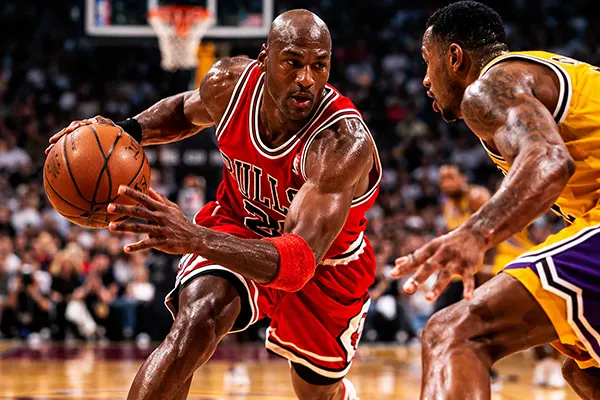
The fadeaway jumper became one of Michael Jordan’s signature moves during the 1990s. As defenders grew stronger and more physical, Jordan adapted by leaning slightly backwards while releasing the ball. This motion increased the distance between the shooter and the defender without sacrificing balance.
Executing the fadeaway requires precise coordination. The player must generate lift while maintaining shooting alignment in mid-air. Jordan’s mastery of this move allowed him to score against defenders who otherwise had the size advantage.
The fadeaway remains one of the most recognisable techniques inherited from Jordan. It is particularly useful late in games when defences tighten and clean driving lanes disappear.
Psychological Pressure and Competitive Edge
Another element of Jordan’s influence is psychological control during key moments. Jordan frequently used defensive intensity, trash talk and relentless competitiveness to unsettle opponents. This mental pressure often forced defenders into mistakes.
Players such as Kobe Bryant adopted a similar mentality, approaching crucial possessions with the expectation that they would take — and make — the deciding shot. This mindset became associated with the so-called “killer instinct” often linked to Jordan’s career.
Today, stars like Giannis Antetokounmpo and Luka Dončić display comparable confidence during late-game situations. While their playing styles differ, the willingness to take responsibility under pressure reflects the competitive culture Jordan helped establish in the NBA.