
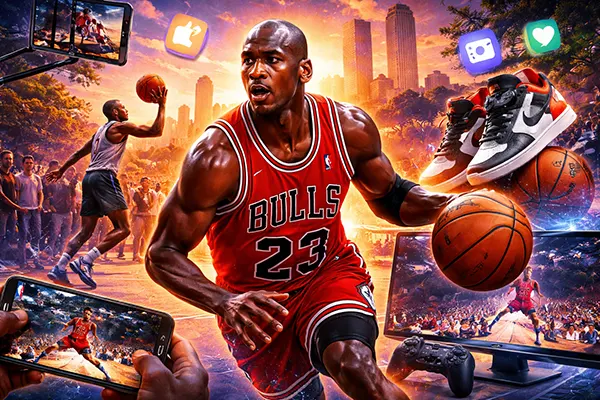
Jordan Beyond the NBA: How Video Games, Streetball and Social Media Reframed a Legend for a New Generation
Michael Jordan’s competitive peak belongs to the 1990s, yet his cultural relevance in 2026 feels remarkably current. For those who never saw him play live for the Chicago Bulls, Jordan is not just an archive figure from grainy highlights. He exists in high-definition gameplay, in streetball aesthetics, in sneaker culture feeds and in the endless scroll of social platforms. What happened after his final NBA retirement is as important as what he achieved on court. Video games, playground basketball and digital media have effectively reintroduced him to audiences born decades after his sixth championship.
From Hardwood to Console: The Role of Video Games in Preserving Jordan’s Aura
Jordan’s relationship with basketball video games has evolved significantly since the early 1990s, when licensing disputes briefly kept him out of certain titles. By the 2010s and 2020s, however, his presence in the NBA 2K franchise became central to how younger fans experienced basketball history. The NBA 2K11 “Jordan Challenge” mode, later reimagined in anniversary editions, allowed players to recreate his most iconic performances with period-accurate rules, arenas and commentary. For many teenagers, this was not nostalgia but first contact.
By 2026, sports gaming technology offers near-photorealistic graphics, advanced motion capture and historically faithful playbooks. Jordan’s footwork, fadeaway mechanics and defensive intensity are coded with precision, informed by archival footage and biometric analysis. Players can simulate the 1991 Finals, compare his ratings against contemporary stars and even test hypothetical matchups across eras. In this environment, Jordan is not frozen in myth; he is measurable, playable and constantly debated.
Crucially, gaming has shifted Jordan from a distant legend to an interactive benchmark. Young fans no longer rely solely on highlight compilations or second-hand storytelling. They experience his tendencies: the way he attacks the mid-post, the timing of his pull-up, the stamina demands of 1990s defensive schemes. Through gameplay, the mythology is grounded in mechanics.
Interactive Legacy and the Business of Digital Nostalgia
The commercial dimension matters as well. Special editions of NBA 2K featuring Jordan on the cover consistently rank among the franchise’s best-selling versions. His brand, under Nike’s Jordan line, is integrated into in-game apparel, MyPlayer customisation and online tournaments. Digital sneakers mirror real-world releases, reinforcing the loop between sport, fashion and gaming culture.
This synergy extends beyond aesthetics. Esports competitions built around basketball simulation have grown steadily, with organised leagues and streaming audiences in the millions. When players select classic Bulls line-ups in competitive play, Jordan becomes part of a live, contemporary spectacle. His digital avatar competes against modern stars controlled by professional gamers, blurring generational boundaries.
As a result, Jordan’s relevance is not dependent on documentary releases or anniversary retrospectives. It is embedded in a living ecosystem where history is updated, patched and rebalanced. The legend is not archived; it is reissued in every annual update.
Streetball Culture: How Playground Basketball Kept the Myth Alive
While the NBA defined Jordan’s professional career, streetball preserved the stylistic essence of his game. The mid-air adjustments, the shoulder feints, the footwork in tight spaces – these elements translate naturally to playground settings. Across American cities and increasingly across Europe and Asia, outdoor courts remain laboratories of imitation. Generations who never saw him at Madison Square Garden still practise his fadeaway against chain-link fences.
Streetball tournaments, from Rucker Park in New York to pro-am circuits in Los Angeles, frequently invoke Jordan as a stylistic reference point. Commentators describe a smooth scorer as having “Jordan-esque” balance. The language itself keeps him embedded in basketball vocabulary. Even as the modern game leans towards three-point volume and positionless systems, one-on-one scoring remains a core skill celebrated on outdoor courts.
By 2026, the globalisation of street culture through online video has amplified this effect. Clips of local players mimicking Jordan’s footwork circulate on short-form video apps, often paired with archival audio or retro graphics. The aesthetic of the 1990s – baggy shorts, black-and-red colourways, aggressive isolation play – is repackaged as authentic and timeless.
Air Jordan, Identity and the Visual Language of Influence
No discussion of Jordan outside the NBA is complete without acknowledging the Air Jordan brand. What began in 1985 as a controversial sneaker deal has become one of the most powerful cultural labels in sport. By 2026, the Jordan Brand operates as a multi-billion-pound global business, sponsoring athletes across basketball, football and even motorsport.
On street courts, the Jumpman logo functions as a badge of lineage. Wearing a pair of retro Jordans is not merely a fashion choice; it signals participation in a shared narrative of competitiveness and style. Limited releases generate queues and online raffles, while resale markets maintain high valuations for classic models. The shoes anchor Jordan’s image in everyday life.
Importantly, the brand has adapted to sustainability standards and evolving consumer expectations. Recent collections incorporate recycled materials and transparent supply-chain reporting, reflecting broader shifts in the sportswear industry. This responsiveness prevents the brand from becoming a museum piece. It remains contemporary, even as it trades on heritage.
Social Media and the Algorithmic Rebirth of a 1990s Icon
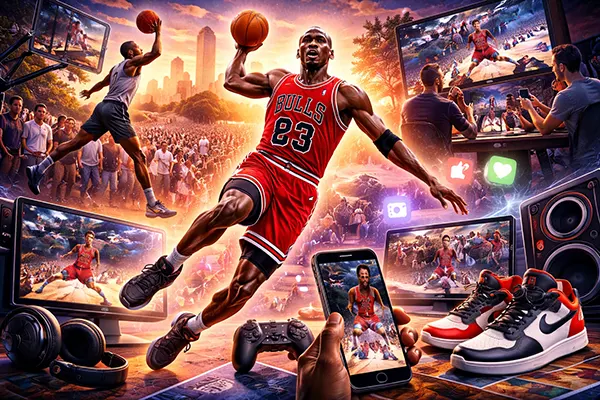
If video games made Jordan interactive and streetball made him tangible, social media made him omnipresent. Platforms such as Instagram, TikTok and YouTube host countless micro-narratives: breakdowns of his footwork, statistical comparisons with LeBron James, AI-enhanced highlight restorations in 4K resolution. The algorithm continuously reintroduces him to users who may not actively search for 1990s basketball.
The 2020 documentary series “The Last Dance” marked a turning point, triggering a measurable spike in global search interest and merchandise sales. That wave has not entirely receded. Instead, it established a template for serialised sports storytelling that continues in spin-off interviews, podcasts and short-form analysis clips. Jordan’s persona, once tightly controlled, is now refracted through thousands of creators.
Data culture plays a role here. Advanced metrics and historical databases allow analysts to contextualise Jordan’s efficiency, usage rates and defensive impact against modern benchmarks. Debate thrives online, and Jordan’s name trends whenever conversations about the “greatest of all time” resurface. Controversy sustains visibility.
Myth, Memory and the Risks of Digital Overexposure
Constant circulation, however, carries risks. Selective highlight editing can flatten complexity, reducing a nuanced career to a sequence of clutch shots. Social media discourse often rewards polarisation, framing Jordan either as untouchable perfection or as an overrated beneficiary of a weaker era. Both extremes oversimplify historical context.
Yet the broader effect remains powerful. Digital platforms allow archival footage to be restored, slowed down and examined from angles unavailable to 1990s audiences. Coaching channels dissect his defensive positioning; sports psychologists analyse his competitive mindset. In this sense, the online environment deepens rather than dilutes understanding.
By 2026, Jordan’s legacy exists simultaneously as memory and as data. It is preserved in box scores, re-enacted in gaming engines, embodied in trainers and debated in comment sections. The NBA years built the legend, but it is the post-playing ecosystem of media, commerce and culture that keeps it alive for generations who know him first through a screen.