
Air Jordan 14 Forest Green Returns in 2026: The Story Behind the 2005 Original
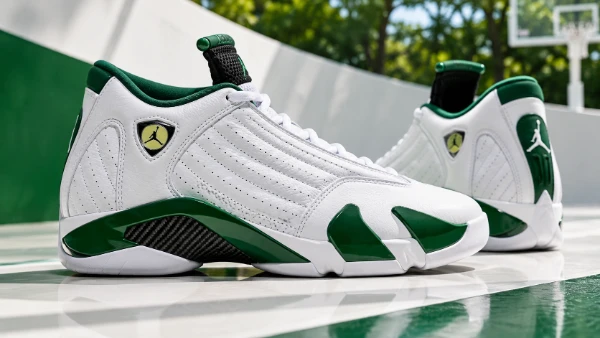
The Air Jordan 14 Forest Green has returned after a 21-year absence, bringing one of Jordan Brand’s distinctive mid-2000s colourways back into the spotlight. Originally released in 2005, the white-and-green basketball trainer received its first retro edition on 31 October 2026, with a US retail price of $215. Its return connects two important periods in Air Jordan history: the Ferrari-inspired design associated with Michael Jordan’s final Chicago Bulls championship and the more experimental colour combinations introduced after his retirement. The 2026 edition retains the familiar white leather construction, deep green detailing and distinctive racing-inspired silhouette, while introducing the colourway to a new generation of collectors. Understanding why this particular release matters requires looking beyond its appearance to the history of the Air Jordan 14, the circumstances surrounding the 2005 original and the details of the new version.
The History of the Air Jordan 14 Forest Green and Its 2005 Debut
The Air Jordan 14 occupies a special position in Michael Jordan’s signature footwear collection because of its association with the closing moments of his Chicago Bulls career. Designed by Tinker Hatfield, the silhouette drew inspiration from Jordan’s Ferrari 550 Maranello, incorporating elements associated with Italian performance cars. Its aerodynamic profile, shield-shaped branding, sculpted midsole and prominent ventilation details gave it an appearance unlike the basketball shoes that preceded it. Although the model reached retailers in 1998, its history began on the court during the NBA Finals that same year. Jordan wore an early version of the Air Jordan 14 during Game 6 against the Utah Jazz, when his decisive jump shot helped Chicago secure its sixth championship. That moment established the model’s connection with one of basketball’s most recognisable sporting achievements.
By 2005, the circumstances surrounding Jordan Brand were considerably different. Michael Jordan had completed his final NBA retirement in 2003, and the company was expanding its existing signature models through retro releases and colour combinations that were not necessarily linked to Chicago Bulls uniforms. The Forest Green edition emerged during this period, offering an alternative to the familiar black, red and white combinations traditionally associated with Jordan’s playing career. Its predominantly white leather upper was complemented by rich green detailing around the midsole, tongue and branding, creating a restrained appearance that contrasted with some of the more colourful releases of the period. The original was not a shoe Jordan had worn during his championship seasons; rather, it represented the continuing development of his footwear collection after his retirement.
The 2005 Forest Green release became part of a wider movement that gradually changed the way enthusiasts approached retro Air Jordans. Earlier releases often attracted attention because they reproduced shoes directly associated with famous games, championship victories or memorable photographs of Jordan himself. Newer colourways offered collectors another reason to appreciate an existing silhouette: its design could support combinations that had never appeared during the athlete’s professional career. Forest Green demonstrated this approach through a relatively simple arrangement of white and green, allowing the technical shapes of the Air Jordan 14 to remain prominent. Its long absence from official releases subsequently increased its historical interest, particularly among enthusiasts who remembered buying or seeing the original pair during the mid-2000s.
Why the Air Jordan 14 Became Associated with Ferrari and Michael Jordan’s Final Championship
The Ferrari connection is more than a decorative reference. Hatfield’s design translated the proportions and visual character of a high-performance sports car into a basketball shoe. The long, low-looking upper suggests a streamlined vehicle body, while the angular midsole sections resemble aerodynamic components. One of the most recognisable features is the shield-shaped emblem positioned near the ankle, which replaces the conventional appearance of a large side-mounted Jumpman with branding reminiscent of a sports-car badge. The shoe also incorporates metallic and carbon-fibre details that reinforce its automotive influence. These elements give the Air Jordan 14 a distinctive identity, particularly when compared with the rounded shapes and more prominent external branding found on several earlier Air Jordan models.
The historical connection became especially important on 14 June 1998, when the Chicago Bulls faced the Utah Jazz in Game 6 of the NBA Finals. With Chicago trailing late in the fourth quarter, Jordan scored the basket that put the Bulls ahead 87–86. His jump shot over Bryon Russell, followed by Utah’s unsuccessful final possession, secured the championship and completed Chicago’s second run of three consecutive NBA titles. Jordan was wearing the black-and-red Air Jordan 14 associated with the Last Shot nickname, not the Forest Green version that appeared seven years later. This distinction matters because the two shoes share the same underlying design but represent different moments in the history of Jordan Brand. The silhouette carries the championship connection, while Forest Green belongs to the later retro era.
Another characteristic of the Air Jordan 14 is the way its performance features influence its appearance. The original design incorporated responsive cushioning, a supportive midfoot structure and a low-profile construction intended for quick basketball movements. Ventilation openings and textured panels added practical details without disrupting the racing-car theme. Unlike many lifestyle trainers that rely primarily on colour or oversized branding, the Air Jordan 14 has a recognisable shape even when viewed from a distance. Forest Green makes that shape particularly visible because the light upper contrasts with the darker sections running along the lower portion of the shoe. This balance helps explain why the 2005 edition remained recognisable despite spending more than two decades without an official return.
Air Jordan 14 Forest Green 2026: Release Date, Design and Main Features
Jordan Brand officially brought back the Air Jordan 14 Forest Green on Saturday, 31 October 2026, marking the colourway’s first return since its 2005 debut. The adult edition carries style code 487471-300 and the official colour description Gorge Green/White/Light Graphite/Light Graphite. Its recommended US retail price was $215, while the European Nike SNKRS release was listed at €219.99 in participating markets. The launch took place through Nike SNKRS and selected Jordan Brand retailers, including established footwear chains and specialist trainer shops. Although the release was announced internationally, purchasing arrangements differed between countries, and the listed prices should not be interpreted as universal. Availability after launch also depends on local stock, size and the retailer involved.
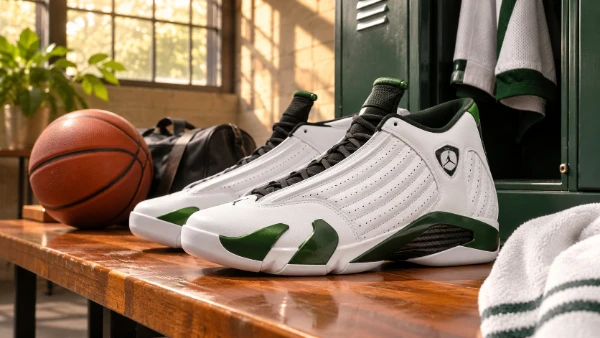
The 2026 version closely follows the visual arrangement of the original Forest Green. White leather dominates the toe, heel and side panels, while the darker green appears on the angular midsole sections, tongue details, rear accents and Ferrari-inspired shield emblem. Light graphite provides additional contrast, preventing the overall design from looking entirely white and green. The textured and perforated side panels remain an important part of the Air Jordan 14’s appearance, providing visual depth alongside the smoother leather sections. Metallic accents and carbon-fibre components reinforce the connection with the 1998 silhouette. Rather than introducing a substantially different colour arrangement, the new release concentrates on recreating the familiar appearance that made the 2005 edition recognisable.
One notable development is the introduction of grade-school sizing alongside the adult release. The children’s version arrived on the same date with a US retail price of $155 and style code 487524-300. This gives younger wearers access to a colourway that was previously associated primarily with the original adult release. The adult and grade-school versions should nevertheless be treated as separate products when checking stock or comparing listings, as their style codes and available sizes differ. The return also fits a broader 2026 Jordan Brand programme that revisited several colourways from the 2000s, including the Air Jordan 14 University Blue. Forest Green is particularly significant within that programme because Nike identifies the new edition as the first official return of the colourway since 2005.
Materials, Cushioning and Differences Between the 2005 and 2026 Editions
The 2026 Air Jordan 14 Forest Green combines a premium leather upper with a foam midsole, Air Zoom cushioning and a durable rubber outsole. According to Nike’s official product information, the leather construction is intended to provide durability and comfort, while the cushioning contributes to a responsive feeling underfoot. The rubber outsole supplies traction for movement on suitable surfaces, and the midfoot includes carbon-fibre detailing associated with the Air Jordan 14’s performance heritage. These are important features for anyone interested in wearing the shoes regularly rather than storing them as collector’s items. Nevertheless, the presence of basketball-inspired technology does not mean that every wearer will experience the same degree of comfort, especially when comparing the shoe with modern basketball footwear developed using more recent construction methods.
Visually, the most important similarity between the two generations is the preservation of the original colour blocking. The 2005 shoe featured the contrast between a white leather body and dark green details that made the edition distinctive. The 2026 release retains this combination, along with the sculpted midsole, perforated upper sections, rear branding and shield-shaped emblem. The modern product also carries the finishing details commonly associated with the Air Jordan 14, including metallic touches and a carbon-fibre midfoot component. However, claims about exact differences in leather thickness, cushioning composition, stitching density or manufacturing quality require direct examination of both editions. Nike has not supplied a comprehensive component-by-component comparison establishing that every material and internal construction detail is identical to the 2005 release.
For collectors examining an original 2005 pair alongside the 2026 edition, age and condition are particularly important. Leather can change in texture over time, adhesives may weaken, and older cushioning materials can become less reliable even when the shoes have remained unworn. A pair preserved in its original box is therefore not automatically suitable for regular wear after more than twenty years. The newer version offers the practical advantage of recently manufactured materials while retaining the appearance associated with the older release. Differences in colour tone may also be influenced by storage, lighting, oxidation and the photographic equipment used to document each pair. Anyone making a serious comparison should use clear photographs taken under similar lighting conditions and, ideally, examine the shoes directly rather than relying exclusively on resale images.
Buying and Collecting the Air Jordan 14 Forest Green in 2026
The return of the Forest Green colourway gives buyers two distinct options: purchasing the newly released 2026 retro or searching for an original pair from 2005. For most people who intend to wear their trainers, the newer edition is the more practical choice because it combines the historic appearance with recently manufactured construction. The 2005 version has a different appeal, especially for collectors interested in original releases, period-correct packaging and the development of Jordan Brand during the mid-2000s. However, an older pair should be assessed as a collectible rather than judged purely by its original retail specifications. Its condition, completeness, authenticity and storage history all influence its desirability. The 21-year gap between releases is historically meaningful, but it does not guarantee that either version will become more valuable.
For buyers looking for the 2026 model, the safest starting point is the official Nike product listing or an established authorised retailer. The adult style code 487471-300 is particularly useful because it identifies the correct edition even when websites use slightly different names for the green shade. Official Nike descriptions use Gorge Green, while the familiar Forest Green nickname continues to appear in release coverage and retailer listings. Checking the full colour description, photographs and size range helps distinguish the release from other Air Jordan 14 editions. In the United States, the original adult retail price was $215, while European prices varied according to market. These launch prices provide a reliable reference when evaluating later offers, but they do not establish current resale values or guarantee that a particular size remains available at retail.
The Air Jordan 14 also deserves attention from buyers considering everyday comfort and styling. Its elongated upper, substantial side panels and distinctive midsole make it visually different from simpler trainers such as the Air Jordan 1 or Air Jordan 3. White leather creates a relatively neutral foundation, while green accents make the shoe suitable for understated outfits built around dark denim, grey trousers, black sportswear or other muted colours. The silhouette is still recognisably a basketball design, so its shape may feel more substantial than a contemporary lightweight lifestyle trainer. Fit should be assessed using the wearer’s usual sizing requirements, and trying on a pair is preferable when possible. Online size recommendations can be useful, but individual foot width and personal preferences for a snug or relaxed fit remain important.
How to Identify an Authentic Pair and Understand Its Collectable Value
Authentication begins with checking the product identity rather than relying on a single visual detail. The adult 2026 Forest Green should carry style code 487471-300, while the grade-school version uses 487524-300. Buyers should compare the box label, internal size tag and overall shoe design with official product photographs. The arrangement of the shield emblem, shape of the midsole, texture of the perforated panels and quality of the stitching can help identify inconsistencies. Nevertheless, counterfeit footwear can reproduce many external details convincingly, so no single feature provides absolute proof of authenticity. Purchasing through Nike or an authorised retailer reduces the risk. For second-hand transactions, clear photographs, proof of purchase and an established authentication service can provide additional reassurance before money changes hands.
Original 2005 pairs require closer inspection because age introduces risks that are unrelated to counterfeiting. Collectors should examine the midsole for cracking, separation or discolouration, check whether the outsole remains securely attached and look for signs of deterioration around the heel and ankle. Original boxes, labels and accessories may add historical interest, particularly when the packaging is in good condition. However, a complete box does not automatically prove that the shoes are genuine, and an unworn description should not be confused with a guarantee of structural integrity. Buyers should request recent, detailed photographs and avoid assuming that older leather or cushioning will perform as intended. These considerations are especially relevant when an original pair commands a higher asking price because of its age or relative scarcity.
The long-awaited return of the Air Jordan 14 Forest Green is significant primarily because it restores a genuine 2005 colourway rather than introducing another reinterpretation of the familiar silhouette. The release connects the Ferrari-inspired Air Jordan 14 with a period when Jordan Brand was developing its identity beyond Michael Jordan’s playing career. Its appeal rests on several concrete qualities: a recognisable white-and-green design, an established connection to the 1998 championship-era model and a 21-year interval between official releases. For buyers, the 2026 edition offers a practical opportunity to own that design without the complications associated with ageing footwear. For collectors, the relationship between the two releases provides a useful example of how early retro colourways have become part of Air Jordan history in their own right.