

Michael Jordan as a Competitor: What Set His Mentality Apart from Other NBA Legends
Michael Jordan is often described through statistics, trophies, and iconic moments, but those elements alone do not explain why he consistently outperformed other elite players under pressure. His true competitive advantage was psychological. Jordan approached competition as a personal confrontation, where winning was not simply an objective, but a necessity tied to identity, control, and self-validation. Understanding this mindset helps explain both his dominance and the cost that came with it.
Failure as Fuel Rather Than a Setback
Jordan’s relationship with failure was fundamentally different from that of most elite athletes. Early in his career, being cut from his high school varsity team became a defining reference point rather than a trauma. He internalised the experience as proof that effort and emotional discomfort were permanent requirements for success, not temporary phases. This perspective shaped how he reacted to every later defeat.
Playoff losses, particularly against Detroit in the late 1980s, were not processed as shared team shortcomings. Jordan treated them as personal defeats that demanded a response. He adjusted his body, his style of play, and his tolerance for physical punishment. Instead of distancing himself emotionally from losses, he leaned into them, replaying details until they became motivators rather than distractions.
This approach removed any comfort zone around losing. Failure was allowed to exist, but never to settle. That distinction mattered. Many legends accepted defeat as part of sport; Jordan treated it as a temporary violation that had to be corrected through action.
Emotional Memory as a Competitive Tool
Jordan had an exceptional ability to store emotional experiences and retrieve them at will. Missed shots, critical comments, or perceived disrespect were not forgotten once the game ended. He kept them accessible, using them to heighten focus before future matchups. This was not accidental behaviour, but a deliberate method of self-stimulation.
Unlike players who required external motivation, Jordan created internal conflict to maintain intensity. He often exaggerated slights or invented narratives of opposition to ensure he never entered a game emotionally neutral. The objective was psychological sharpness, even if the source was artificial.
This habit explains both his consistency and his volatility. Emotional memory gave him control over his competitive state, but it also prevented emotional detachment. The same mechanism that drove peak performances made relaxation and balance difficult.
Interactions with Teammates and Opponents
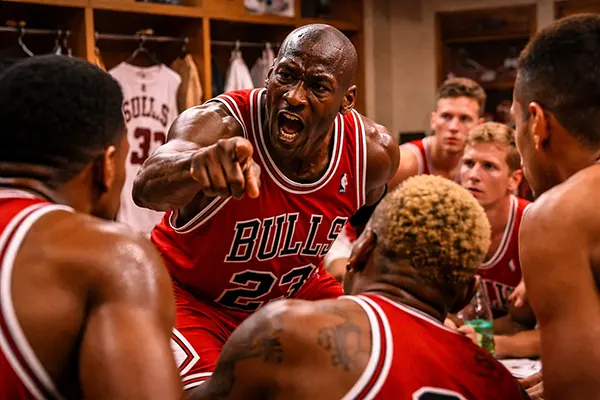
Jordan’s leadership style was confrontational and uncompromising. He did not prioritise harmony or emotional comfort within the team environment. Instead, he demanded that teammates meet his internal standards, often through direct criticism or public challenges. This behaviour created tension but also clarity about expectations.
With opponents, Jordan showed little interest in mutual respect during competition. Games were psychological contests where intimidation, eye contact, and body language mattered. He aimed to dominate mentally before physical advantages even became relevant.
This approach separated competition from personal relationships. Respect could exist after the final whistle, but never during the contest itself. For Jordan, emotional distance during play was a weakness.
Pressure as a Filter for Commitment
Jordan believed pressure revealed rather than created character. His harsh treatment of teammates was rooted in the belief that elite performance required emotional durability. Those who could not function under criticism were, in his view, not prepared for championship-level demands.
This created a self-selecting environment. Players who adapted often improved rapidly, gaining confidence in high-stress situations. Those who resisted either adjusted their mindset or gradually lost relevance within the rotation.
While this method produced results, it also narrowed the emotional bandwidth of the team. Psychological safety was sacrificed in favour of accountability and resilience.
Why His Leadership Model Worked
Jordan’s leadership was effective because it aligned perfectly with his own behaviour. He demanded extreme commitment, but modelled it consistently through preparation, physical conditioning, and willingness to take responsibility in decisive moments. This consistency gave credibility to his intensity.
He also simplified the team’s mental framework. The objective was clear: win, regardless of discomfort. Ambiguity about roles, effort levels, or priorities was removed. In high-pressure environments, this clarity reduced hesitation and decision fatigue.
Importantly, Jordan accepted being disliked if it served performance. He did not seek validation as a leader; he measured success solely through outcomes.
Limits of Sustainability
While effective in the short and medium term, this leadership style relied heavily on a unique personality and exceptional talent. It worked because Jordan could consistently justify his demands through results. Without that foundation, similar behaviour risks becoming destructive.
The model also required a supporting structure capable of absorbing emotional stress. Coaches and management played a critical role in mediating conflict and maintaining functional boundaries.
As sports psychology evolved, emphasis shifted towards long-term wellbeing, communication, and adaptability. Jordan’s approach succeeded within its historical context but required significant personal and organisational cost.
Would This Mentality Work in Modern Sport?
In today’s professional environment, Jordan’s methods would face greater resistance. Modern athletes operate within systems that prioritise mental health awareness, individual expression, and collaborative leadership. Open confrontation is more likely to be questioned than accepted.
However, the core principles behind his mentality remain relevant. Accountability, emotional control, and intolerance for complacency are still essential traits at elite levels. The difference lies in delivery rather than substance.
Modern leaders often translate Jordan’s intensity into structured feedback, data-driven evaluation, and controlled emotional engagement rather than direct confrontation.
Enduring Lessons Without Imitation
Jordan’s mentality should be studied, not replicated blindly. His success was not a template but a case study in how psychological extremes can produce extraordinary results under specific conditions.
The value lies in understanding how he managed motivation, processed failure, and maintained focus, while recognising the personal costs involved. Effective leadership today requires adaptation, not nostalgia.
Jordan remains a benchmark not because his methods were universally applicable, but because they exposed the upper limits of competitive commitment.